


Example story – an AI-generated example for the case study template. The facts and figures are illustrative and will be replaced with real project data.
The client and the need
The client was renovating an old log house in Harju County, where the wooden floors on both storeys had sagged and become uneven over the years. The goal was level floors and water underfloor heating on both storeys. The 80 mm concrete screed in the design would have put too heavy a load on the timber structure, and for an old house it was out of the question.
Why gypsum screed
Gypsum (anhydrite) floor screed needs no reinforcement, does not crack or shrink, and the layer is much thinner than with concrete. Gypsum has good thermal conductivity, so it suits underfloor heating better than concrete. A 50 mm gypsum layer is almost half the weight of an 80 mm concrete screed, which makes it possible to install efficient underfloor heating on the upper storey of a timber house too.
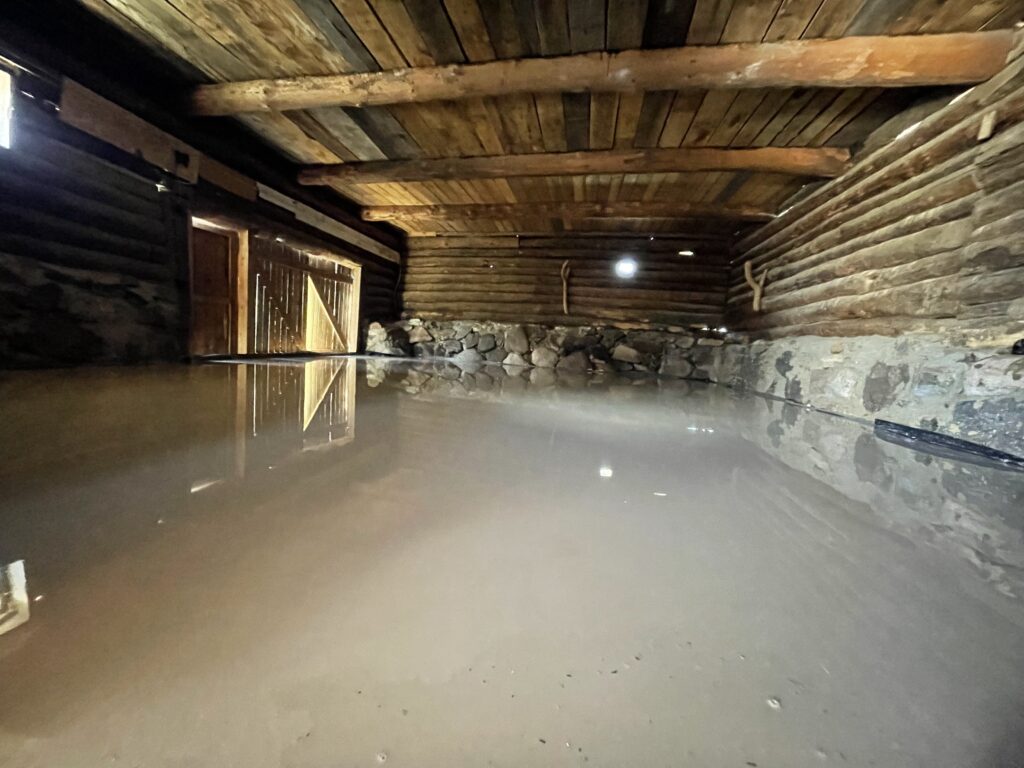
The solution and the work
- The old wooden floor was covered with vapour barrier paper, laid with overlaps and taped at the joints.
- On top, 50 mm EPS insulation boards were laid tightly and without gaps, with plastic film over the boards.
- Edge insulation strip with a film flap was fitted along the walls; the flap was taped to the floor film to keep the corner square.
- The heating installer fixed the heating pipes with clips directly onto the film, with clip spacing of up to 40 cm. No reinforcement was used.
- Before pouring, we checked that all pipes and cables were fixed, the films and edge strips were in place and the stairwell opening was boxed in.
- Knauf FE 50 Largo gypsum compound was pumped through a hose onto the floor from a truck-mounted mixing unit. The self-levelling compound was poured 35 mm above the heating pipes, about 50 mm in total. Both storeys were poured in one day.
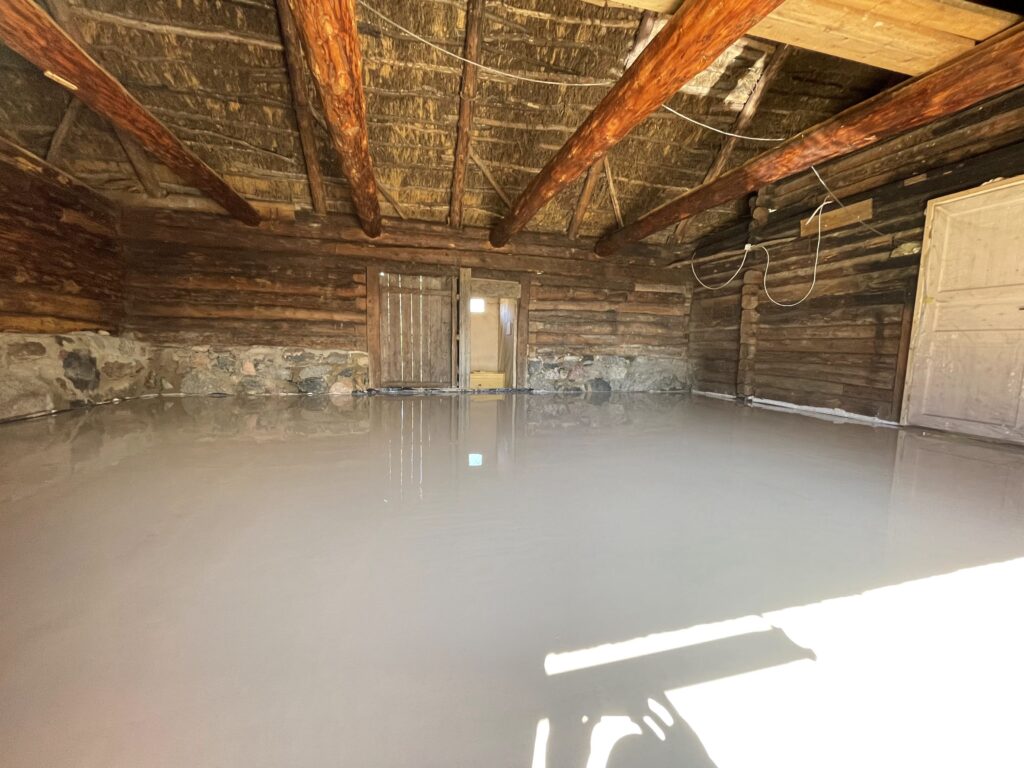
The result
- The floor was walkable after 24 hours, took full load on day 3, and the underfloor heating could be switched on on day 5.
- The floors are smooth and even, ready for parquet and tiles without extra levelling.
- Thanks to the thermal conductivity of gypsum, the 30–40 °C water in the underfloor heating heats evenly and economically.
- On site, Põrandavalu Keskus needed only 3 × 20 A electricity and access to clean water from the client.
In the client’s words
We considered different floor types to use in renovating an old house. After consulting the Põrandavalu Keskus specialists, we were reassured that gypsum screed would be a good solution for us, as it is lighter and can be poured in a thinner layer, which was very important for an old house.
Evelin K